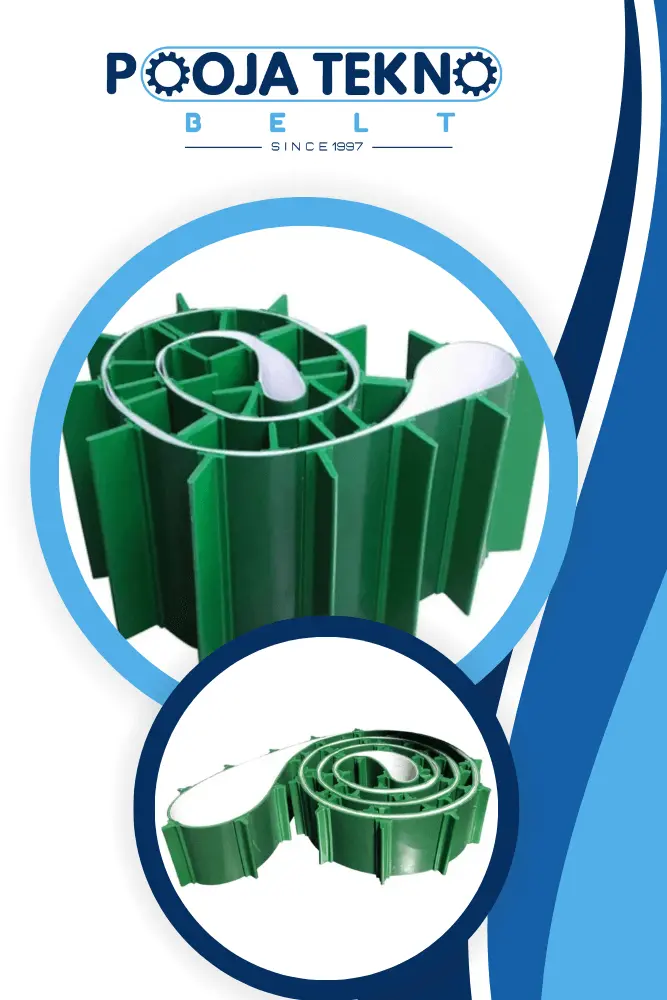
PVC Cleated Conveyor Belts
PVC Cleated Belts are designed for applications where products need to be moved at an incline, decline, or require controlled movement. The cleats act as barriers that securely hold and carry materials without slipping, ensuring smooth and efficient conveying even at steep angles.
Key Features:
- Strong Cleat Bonding – Cleats are welded for high strength and durability.
- Customizable – Available in different heights, pitches, and profiles.
- Non-Slip Movement – Prevents material rollback on inclined conveyors.
- Oil, Moisture & Chemical Resistant – Ensures long belt life in tough conditions.
- Flexible Design – Can be combined with sidewalls for bulk material handling.
Applications
- Food Processing (snacks, bakery, vegetables, grains)
- Packaging Lines
- Agriculture & Seed Handling
- Recycling & Waste Management
- Pharmaceutical & Chemical Industry
Available Range
- Cleat Height: 20 mm to 100 mm
- Cleat Shapes: Straight | Angled | Scoop Type
- Belt Colors: Green | White | Blue
- Surface: Smooth | Rough Top | Diamond Pattern
- Widths: Up to 3000 mm
Custom Fabrication Options
- Cleats (Flights): T-shaped, L-shaped, or V-shaped "stoppers" welded to the belt to carry materiacls up steep slopes without rollback.
- Corrugated Sidewalls: Flexible vertical borders that contain loose or bulk materials (like grains or small parts) to prevent side spillage.
Product Weight & Loading
The weight determines the number of plies (fabric layers) needed for tensile strength.
- Light Loads: A single-ply belt is usually sufficient.
- Medium/Heavy Loads: You will likely need a 2-ply or 3-ply belt to prevent stretching and sagging.
Incline Angle & Surface Grip
If your conveyor isn't perfectly flat, the surface pattern becomes the most important factor.
- 0 TO 15 (Flat/Low Incline): A Smooth or Matte finish is easiest to clean.
- 15 TO 30 (Medium Incline): A Rough Top or Diamond Pattern provides the necessary friction to stop products from sliding back.
- 30 DEGREE (Steep Incline): You will likely require Cleats (welded T-shaped ribs) to "bucket" the product upward.
How to Calculate the Required Cleat Height
If you are moving bulk items (like loose nuts or plastic parts) up a steep slope, the cleat height (H) should generally be at least 50% of the product's maximum diameter to ensure stability.
H CLEAT ≥ 0.5 X D PRODUCT
Infrastructure
At Pooja Teknobelt Pvt Ltd, our advanced infrastructure forms the backbone of our operations. Our 12,500 sq. ft. facility in Surat is systematically organized into specialized departments to ensure smooth and efficient workflow.
With well-defined working zones, separate storage systems, advanced machinery, and ERP-based management, we maintain streamlined production, strict quality control, and dependable delivery performance.
Why Us?
At Pooja Teknobelt Pvt Ltd, we combine industry expertise, advanced manufacturing, and a commitment to fast response. Our focus is not just on supplying belts, but on delivering reliability, precision, and long-term value to every customer.
Driven by quality standards, organized systems, and a customer-first approach, we ensure consistent performance and dependable service every time.
Team Work
At Pooja Teknobelt Pvt Ltd, our strength lies in our people. Our dedicated and quality-driven team works with precision, responsibility, and a shared commitment to excellence.
From production to dispatch, every member focuses on maintaining standards, meeting timelines, and ensuring that each belt delivered reflects our promise of reliability and performance.